This website uses cookies for the purpose of digital analytics, improving your user experience and personalising publicity. You can view our cookie policy here.

Jul 14, 2026, 10:00 AM
Workload studies in the housekeeping department are no longer just a recommendation — they are now a legal requirement in Spain's leading tourist destinations.
The Balearic and Canary Islands, two of the country's largest hotel regions, have regulated this issue through different routes but with the same goal: planning room attendants' shifts on objective criteria.
In the Balearic Islands, the hospitality collective agreement requires hotels to carry out and hand over these studies to worker representatives by 2028. In the Canary Islands, regulation follows two tracks: the Tenerife hospitality agreement has required it since 2018, and the April 2026 amendment to the Tourism Law extended it across the whole archipelago, adding mandatory quarterly reviews by each company's Health and Safety Committee.
The requirement didn't come out of nowhere. Room attendants have historically had one of the highest rates of temporary disability and musculoskeletal injury in the services sector. In 2023, 4,364 work accidents with sick leave were recorded in the accommodation sector in the Canary Islands, almost all minor but accumulating day after day.
In both regions, failing to carry out these studies can also lead to sanctions under occupational risk-prevention law, turning the issue into a legal risk, not just a labour one.
A workload study is a formal analysis that measures the real effort a room attendant's shift involves. It takes into account variables such as the number of rooms assigned, room type, room status (checkout, check-in or occupied), additional tasks required, and movement between floors or zones.
The Balearic hospitality collective agreement states that hotels must carry out these studies and make them available to worker representatives. The reason is clear: housekeeping work is physically demanding, and distributing it without objective criteria creates accumulated overload that, over time, leads to sick leave, musculoskeletal injuries and staff turnover.
Not carrying out these studies isn't just a breach of the collective agreement — it's also a legal risk under occupational risk-prevention law.
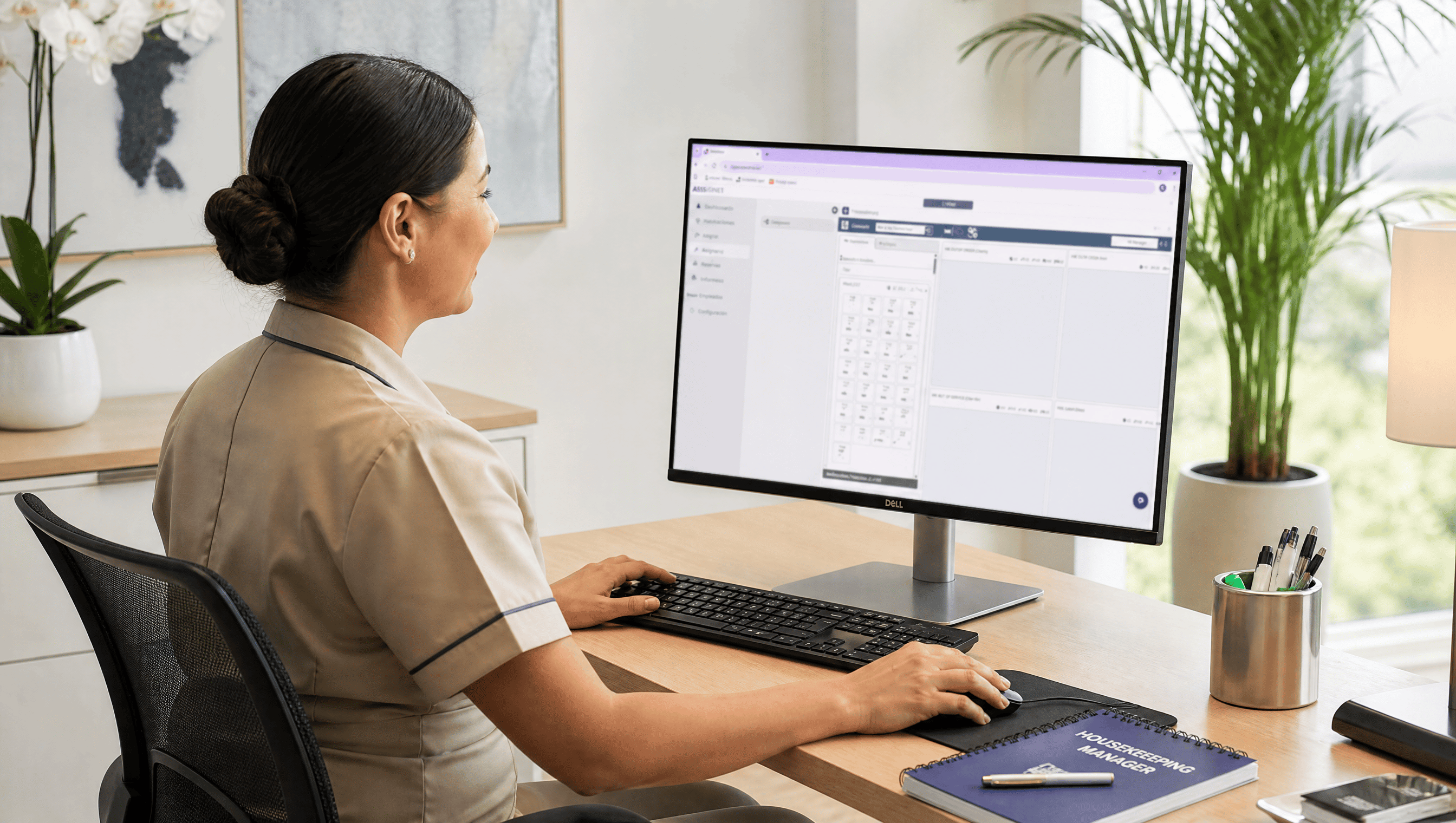
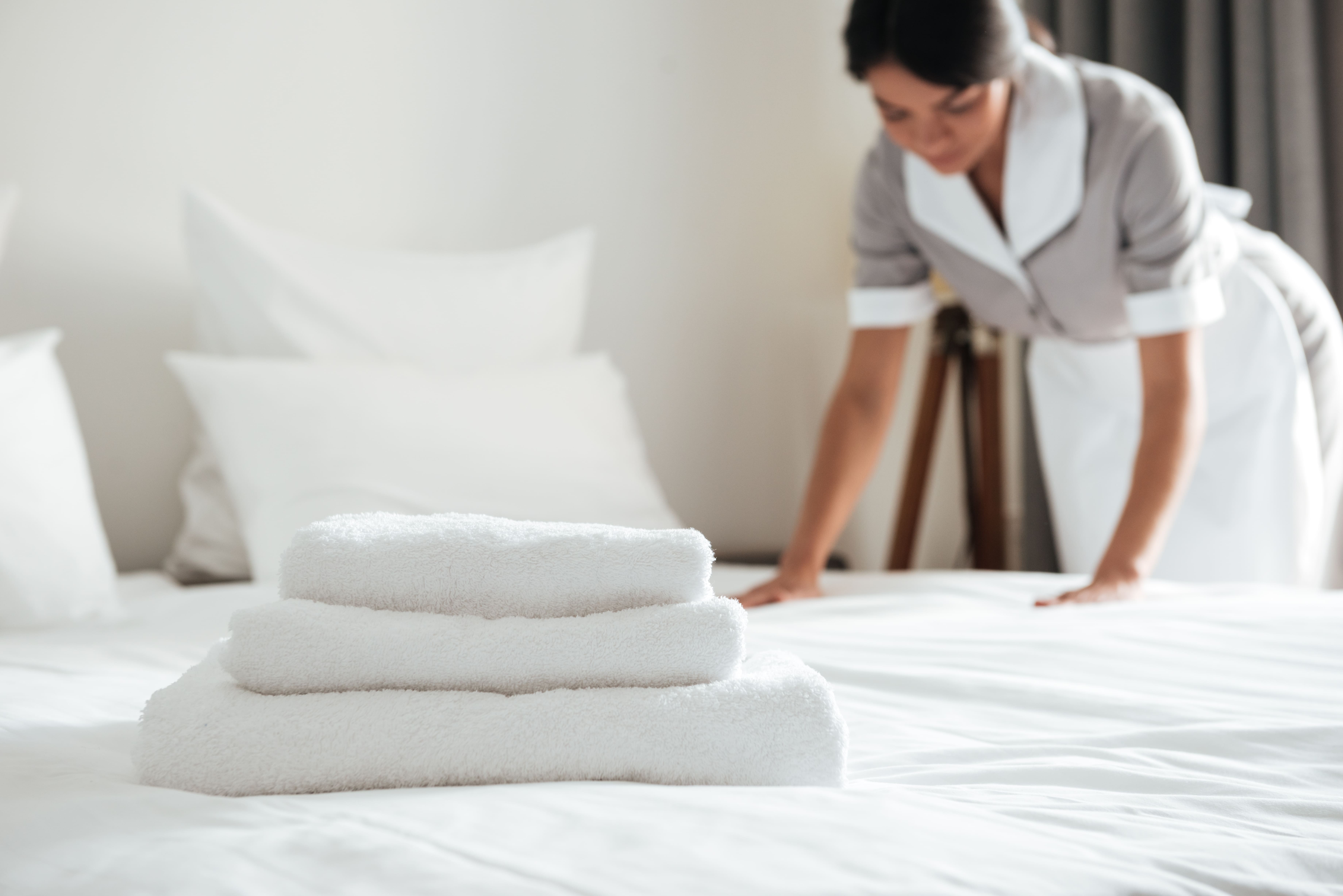 Housekeeping staff working in a hotel room.
This is one of the most widespread — and most damaging — assumptions in the sector. Splitting rooms by ratio is not the same as splitting work evenly.
Real workload varies substantially depending on each room's characteristics, so room count alone doesn't reflect effort. A checkout clean, for example, demands far more effort than a daily service clean. Occupancy also matters directly: servicing a standard room occupied by 3 guests is not comparable to one occupied by 2.
As a result, if one attendant is assigned five checkout rooms and another five daily-clean rooms, both will have the same number of rooms on their worksheet, but the real physical load will be completely different.
On top of that, not every shift is equal. In high season, pressure increases considerably: more turnovers, higher demand for amenities, and stricter inspections. Especially in "sun and beach" hotels, summer workload changes significantly due to factors like sand on terraces and longer cleaning times. Without a system to capture and distribute this complexity, room splitting is done by guesswork — with the wear and tear that causes across the team.
Points- or time-based assignment is a planning system that translates each room's complexity into a numerical value. The specific unit —points, time, credits, or another equivalent— is defined according to what best fits each property. Each task scores based on objective criteria:
- Room type: depends on the size and characteristics of each room type.
- Status: a checkout clean scores higher than a daily service clean.
- Additional tasks: adding a cot, restocking special amenities, or preparing a VIP room add extra points.
- Logistical factors: some models also account for movement between rooms or floors.
The result is that work is distributed not by room count but by real workload. If the housekeeping manager sets a shift threshold (say, 450 points or its time equivalent), the housekeeping manager distributes rooms until each attendant reaches that threshold in a balanced way.
Implementing points- or time-based assignment effectively requires, above all, defining scoring criteria tailored to the property and having up-to-date information on room status. This system can work just as well on paper or in a spreadsheet as with a digital tool: what makes the difference is that the criteria be objective and consistently applied — not the medium used to manage it.
A digital tool doesn't replace that criteria, but it does make day-to-day application easier: it speeds up distribution, reduces management time, and leaves an automatic record of each shift.
At hotels using the EISI HOTEL Housekeeping module, this process is built into daily operations. Based on the data provided, the EISI HOTEL consultant configures scoring values to match the property's standards, and the housekeeping manager assigns and manages rooms using a traffic-light system to check whether the assignment is optimal and fairly distributed.
Room attendants receive their day's assignment directly on their mobile device, with rooms ordered by zone and clear instructions for each one. When last-minute changes come up (an early checkout, a special request), the housekeeping manager can reassign directly from the system, with no calls or paperwork needed.
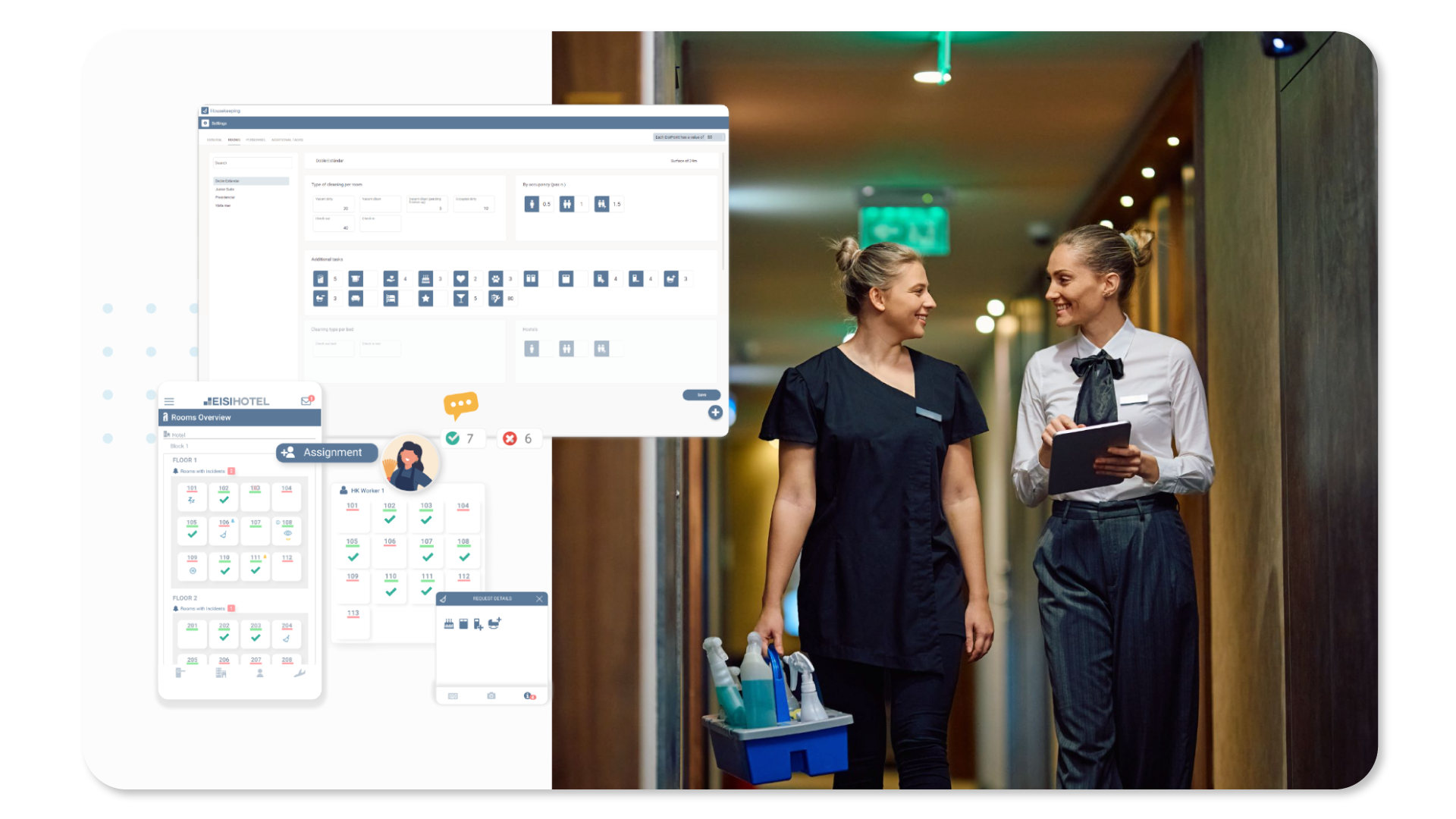
Excerpt from the EISI HOTEL Housekeeping module
Hotels that apply room distribution based on real workload —whether managed on paper or with a digital tool— report improvements on several fronts. Where digitisation also exists, these benefits are amplified:
For the operational team (room attendants):
- Guaranteed labour equity: points- or time-based assignment ensures fair distribution and balanced workload management, regardless of the medium used.
- Clarity from the start of the shift: each attendant knows their workload based on explicit criteria, not informal assignment. Where a digital tool exists, access is instant via mobile device, eliminating dead time and paper worksheets.
- Real-time, two-way communication: with a digital tool, immediate receipt of priority updates (status changes, unexpected checkouts or VIP requests) without unnecessary trips or disruptive radio calls.
For management and supervision (housekeeping managers and supervisors):
- 360° control and visibility: real-time monitoring of cleaning progress and room availability status across the property.
- Dynamic restructuring: agility to reassign tasks for any unforeseen event (late check-outs, technical issues) centrally, without disrupting the team's workflow.
- Traceability and data analytics: automatic record of time, task and incident history. This analytical base simplifies drafting and later complying with the workload study required by the collective agreement.
For hotel management:
- Optimised Time-to-Room: minimises guest waiting time at reception thanks to synchronisation between housekeeping and reception, speeding up room readiness.
- Automated departmental synergy: native communication integration between housekeeping, reception and technical service teams, resolving faults faster.
- Reduced legal and labour risk: thorough, objective documentary support in the event of labour inspections or occupational risk-prevention audits, protecting the hotel from potential sanctions.
This is precisely where digitisation adds the most long-term value. When housekeeping planning is managed on a digital platform, every shift leaves a record: which rooms were assigned, how many points or how much time each worksheet added up to, how long each task took, and what incidents came up.
These records are the raw material for a workload study. Instead of rebuilding the information from scratch, the hotel already has real data accumulated over the season that can be structured into the report required by the collective agreement.
A system like EISI HOTEL doesn't automatically generate the regulatory report —that process requires human judgement and knowledge of each property's labour context—, nor does it automate daily task assignment, but it does make it easier and faster to consistently apply the parameters and points/time system defined in that study.
The demands raised by different groups in the Balearic Islands are not an attack on hoteliers. They're a reminder that the housekeeping management model in many hotels hasn't been updated in decades. Seasons stretch longer, stays get shorter, cleaning standards get stricter, and hiring gets harder. Managing all that with paper worksheets or informal criteria has a cost that doesn't always show up on the balance sheet — but it does show up in sick leave, staff turnover and service quality.
Committing to fairer, more transparent management of housekeeping work isn't just a legal obligation. It's also a business decision: teams that work with clear criteria perform better, stay longer, and deliver more consistent service.
For more on the role of housekeeping in guest experience and hotel brand, see The Importance of the Housekeeping Department in a Hotel.
Want to know how EISI HOTEL can help manage housekeeping across your hotels?